6.4x ROAS and $4.8M in Revenue for Luminara Jewelry
- Blended ROAS
- 6.4x
- from 1.8x
- Monthly Revenue
- $420k
- Total Revenue Generated
- $4.8M
- Cost Per Acquisition
- -47%
Overview
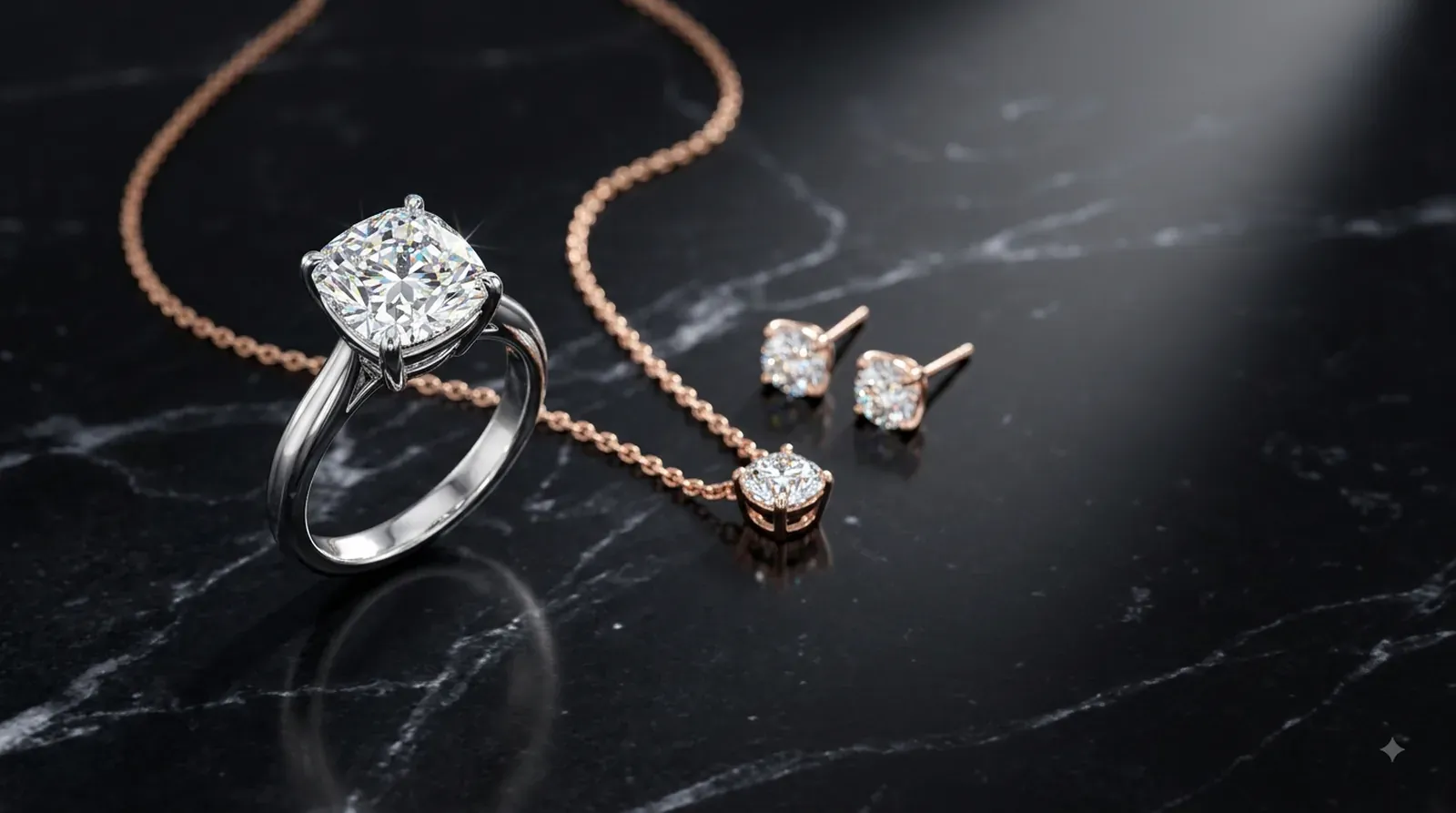
Luminara Jewelry is a direct-to-consumer luxury jewelry brand based in New York, selling lab-grown and fine jewelry exclusively through Shopify at a $480 average order value. We started working with Luminara in January 2025, when monthly revenue run-rate sat around $165k on $120k of ad spend, with blended ROAS near 1.8x. Fourteen months later, monthly revenue run-rate has grown to $420k and blended ROAS sits at 6.4x, with $4.8M in total revenue generated across the full engagement.
A trust problem, not a demand problem
A $480 jewelry purchase isn’t an impulse buy. Going into January 2025, the account was still being run like one — heavy creative fatigue on Meta, a weak and largely unoptimized product feed on Google, and almost no systematic remarketing for a buyer who needs multiple touches before she’s ready to spend this much on a single piece.
We treated this as a trust-and-consideration problem, not a raw demand problem, and built the account around giving a high-consideration buyer the touches she actually needs before we asked her to buy.
Four workstreams, each built around consideration time
1. Meta rebuilt around actual high-AOV buyers
We replaced broad prospecting with cold lookalikes built from actual high-AOV purchasers, not general site visitors or broad interest categories. We layered in a mid-funnel engagement tier for people who’d shown real interest without buying, plus aggressive 30- and 90-day remarketing windows — long enough to match the actual consideration window for a purchase this size.
2. Google Shopping & feed rebuild
We rebuilt a product feed that had been left largely unoptimized, then moved to product-level bidding that heavily favored Luminara’s highest-margin collections, rather than spreading spend evenly across a catalog where margin varies by stone and setting.
3. Lifecycle / Klaviyo
We built education-first flows — how lab-grown diamonds are actually made, care guides — as trust infrastructure rather than a discount channel, plus abandoned-cart sequences using real customer photos instead of stock imagery, since a jewelry buyer wants to see how a piece looks on an actual hand.
4. Creative production
We tested polished studio video against close-up, macro-level detail shots to see what actually built trust for a purchase this size. The macro detail shots — letting a stone’s cut and clarity read clearly on a phone screen — consistently outperformed the more generically polished studio video.
What didn't work
Luxury lifestyle targeting, and discounting a $480 diamond
Not everything we tried worked. Here’s what we cut, and why.
Broad “luxury lifestyle” interest targeting
We ran this for about two months on the theory that anyone signaling general luxury affinity was worth reaching. It produced expensive clicks that rarely converted, and we shut it down.
Heavy promotional / discount creative
We also tested heavier promotional, discount-forward creative. It underperformed consistently against full-price storytelling — a pattern worth stating directly, since it reinforces that trust, not price, is what moves this buyer.
- Blended ROAS
- 6.4x
- from 1.8x
- Monthly Revenue
- $420k
Two different revenue figures — kept separate on purpose
The $165k-to-$420k figures are a monthly run-rate snapshot at the start and end of the engagement. The $4.8M figure is the cumulative total generated across the full 14 months. These measure different things and shouldn’t be read as the same kind of number.
The acceleration after March 2025 lines up directly with when the feed rebuild and creative overhaul both went live. Before that, growth was flat off the January starting point — ROAS had barely moved. Cost per acquisition is down 47% over the same window.
AOV rose from $480 to $615 over the engagement, consistent with the shift away from discount-led creative toward full-price, education-first positioning. Some of this growth likely also reflects factors outside the media program: the broader consumer shift toward lab-grown diamonds as a category, and gifting seasonality, since this window includes Valentine’s Day, Mother’s Day, and the Q4 holidays.
From a polished ad to a second purchase or referral
The path a Luminara customer takes today is built around the fact that a $480-plus jewelry purchase rarely happens on the first visit.
Four channels, built around a considered purchase
Four workstreams ran across the engagement: Meta Ads full-funnel restructure, Google Shopping feed rebuild and bid management, Klaviyo lifecycle marketing, and creative production testing.
| Channel / Workstream | What We Did | Why It Mattered |
|---|---|---|
| Meta Ads | Full-funnel restructure: high-AOV lookalike prospecting, mid-funnel engagement, 30/90-day remarketing. | Matched the actual multi-touch consideration window a $480 purchase requires, instead of treating it like an impulse buy. |
| Google Shopping | Rebuilt the product feed and moved to product-level bidding on the highest-margin collections. | Stopped spreading spend evenly across a catalog where margin varies enormously by stone and setting. |
| Lifecycle (Klaviyo) | Education-first flows on sourcing and care, plus real-photo abandoned-cart sequences. | Built trust infrastructure for a high-consideration buyer, rather than leaning on discounting. |
| Creative Production | Tested studio video against macro-level detail photography. | Macro detail — letting cut and clarity read on a phone screen — consistently won on trust-building. |
Luminara against a typical luxury DTC jewelry account
| Metric | Typical Luxury DTC Jewelry Account | Luminara Jewelry (Actual) |
|---|---|---|
| Blended ROAS | Jewelry & accessories average roughly 4.0x on paid social, per Upcounting/Opensend ecommerce ROAS data by category. 1 | 6.4x, up from 1.8x |
| Cost Per Acquisition | DTC fine jewelry typically runs $120–$180 CAC, per Eightx's jewelry financial benchmark report. 2 | Down 47% since January 2025 (absolute CAC not disclosed here) |
$4.8M later, still without a single discount
Blended ROAS moved from 1.8x to 6.4x. Monthly revenue run-rate grew from $165k to $420k, and the engagement generated $4.8M in total revenue across 14 months. Cost per acquisition is down 47%. None of this happened in a straight line, and we don’t think it happened from the media program alone — category tailwinds and gifting seasonality both likely played a role we can’t fully separate out.
When ThinkMedia said the account needed to slow down and build trust before it tried to convert anyone, we listened, even though it felt counterintuitive at the time.
Your budget deserves better.
More results
Other engagements.

3.9x
Blended ROAS
from 1.6x
3.9x ROAS and $265k in Monthly Revenue for a Los Angeles Apparel Brand
We took Vespera Apparel from a single undifferentiated Meta campaign and a 14% repeat purchase rate to a segmented account and real retention infrastructure — nearly tripling blended ROAS along the way.

3.8x
Blended ROAS
from 1.7x
214% Revenue Growth and 37% Lower Cost Per Purchase for an Austin Skincare Brand
We took Velora Beauty from a hero-product-only account with fatigued creative to a routine-building brand — and nearly doubled repeat purchase rate in the process.

3.6x
Blended ROAS
from 1.9x
3.6x ROAS and CAD $325k Monthly Revenue for Havenwood Home
We took Havenwood from product pages that couldn't answer a considered buyer's real questions to a full storytelling system for solid-wood furniture — and more than doubled repeat purchase rate along the way.